


Why You Shouldn’t Evaluate Facade Cost Based Only on the Price per m²
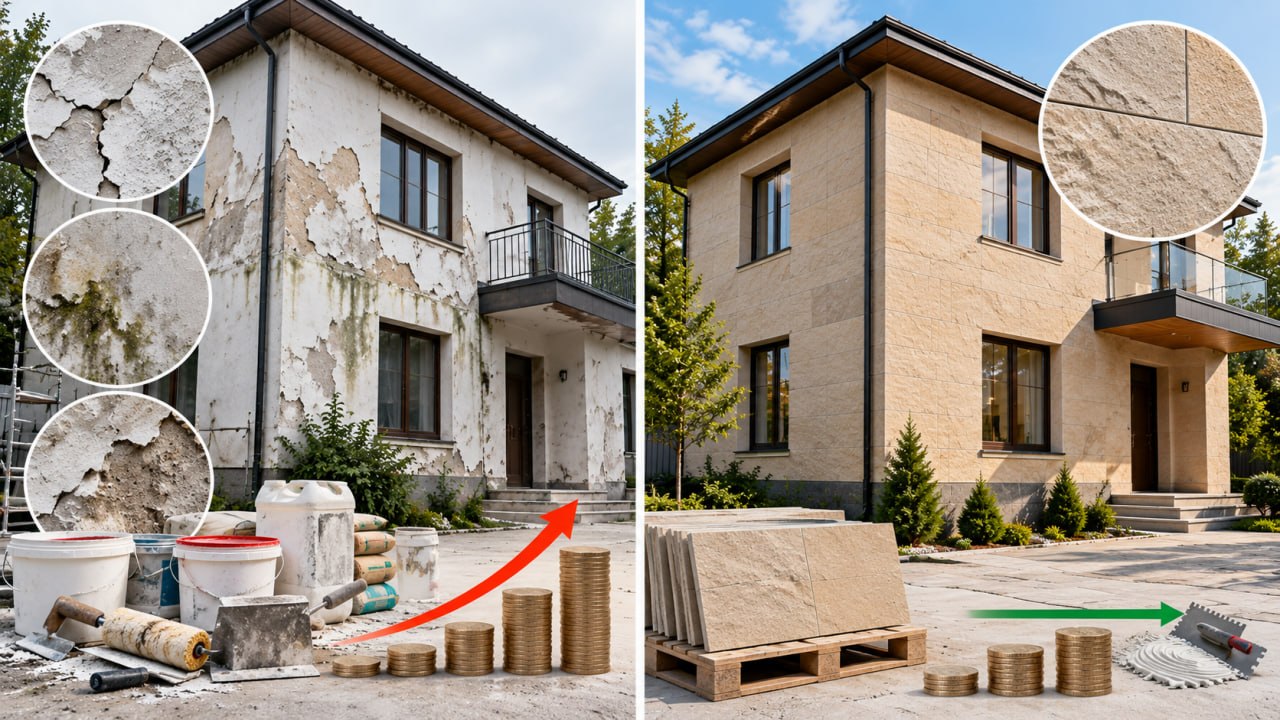
Two materials can cost the same per square metre and the finished facade can come out at very different prices. We break down what the real cost is made of: wall preparation, adhesive and mesh, installation and its speed, scaffolding and delivery, insulation and maintenance after handover, and give the formula for the full cost with a worked example for 200 m².
Two facade materials can cost roughly the same per square meter, yet the final cost of finishing a house can be completely different. The reason is simple: the price of the cladding is only one part of the total expense. Substrate preparation, adhesives, installation, equipment, delivery, and future maintenance all need to be added.
That is why it is incorrect to compare facade render, natural stone, porcelain stoneware, and flexible tile solely by the price of the material. For an objective comparison, it is necessary to consider the cost of the completed facade and the expenses associated with its long-term use.
What Makes Up the Real Cost of a Facade?
When purchasing cladding, the price per square meter is usually the first figure people look at. It is useful for a preliminary estimate, but it does not reflect the full cost of the work.
Depending on the selected material, expenses may include:
- Substrate preparation. Cleaning, repairing damage, leveling, and priming the surface.
- Auxiliary materials. Adhesive, reinforcement mesh, primers, fasteners, and other required components.
- Installation. Labor costs, which depend on the complexity of the work and the characteristics of the material.
- Equipment. Tools, scaffolding, and lifting equipment where required.
- Delivery and unloading. This can become a significant expense when heavy cladding materials are used.
- Maintenance. Cleaning, repainting, repairs, and replacement of individual elements.
As a result, a material with a lower purchase price does not necessarily lead to a lower total project cost.
Why Can Heavy Cladding Cost More?
Material weight affects not only the load on the building, but also the organization of the construction work.
Natural stone and heavy ceramic cladding require appropriate substrate preparation and, in some cases, additional fixings or special structural solutions.
The load-bearing capacity of the wall and the permitted load on the facade system must also be considered.
Heavy products are more difficult to transport, unload, and move during installation. These costs become especially noticeable on large projects or when cladding upper floors.
Lightweight materials can simplify some of these operations.
For example, according to the manufacturer’s technical description, KORDEKO Flexible Tile (PletaFlex) weighs approximately 4 kg/m². This is significantly less than traditional heavy stone cladding.
Its low weight simplifies transportation and handling and allows it to be used on properly prepared structures where heavy stone cladding may be undesirable.
However, the weight of the tile itself is not the same as the weight of the complete facade system. Adhesive, preparation layers, and reinforcement must also be included in the calculation.
Installation Speed Also Affects the Budget
Labor costs are directly related to the number of operations, the complexity of fitting, and the time required to complete the facade.
For example, natural stone installation may involve processing individual elements, cutting, moving heavy slabs, and additional fixing work.
KORDEKO Flexible Tile can be cut with a utility knife or scissors, while installation uses standard cladding tools.
According to the technical description, one installer can lay up to 25 m² of flexible tile per day. This is an approximate figure and should not be treated as guaranteed productivity on every project.
Actual installation speed depends on the condition of the substrate, tile format, number of windows and corners, and other architectural details.
Complex facade geometry has an especially strong effect on labor requirements. Columns, arches, and rounded areas require more fitting when rigid materials are used, while flexible cladding can follow the shape of a properly prepared surface.
For this reason, materials should be compared not only by price per square meter, but also by the installation cost for the specific architecture of the building.
Substrate Preparation: A Cost That Is Often Underestimated
Even if the material itself is inexpensive and quick to install, the condition of the walls can significantly affect the budget.
Older facades often have cracks, peeling plaster, and uneven surfaces. These defects must be repaired before new cladding is installed.
For KORDEKO, surface preparation includes cleaning, checking the strength of the substrate, leveling where necessary, and priming. OSB and sandwich panels require additional preparation, including reinforcement with fiberglass mesh.
That is why quotations from different contractors should be compared using the same scope of preparation work.
If one estimate includes substrate repair while another only includes tile installation, the difference in price does not necessarily mean that the second option is truly cheaper.
How Does Insulation Change the Cost of a Facade?
When a homeowner wants to improve both the appearance of the building and its thermal performance, cladding cannot be considered separately from insulation.
Facade Insulation involves additional materials and work: insulation boards, fixing, reinforcement, priming, and the final finish.
The general requirements for external thermal insulation composite systems (ETICS) are set out in the European assessment documents published by EOTA.
The selected cladding affects the design of this system.
Heavy finishing materials may require additional fixing solutions and verification of permitted loads. Lighter cladding can reduce the load on the prepared reinforcement layer, provided that all components are compatible.
KORDEKO can be used in exterior thermal insulation systems with expanded polystyrene or mineral wool, where the flexible tile acts as the final finish.
The actual reduction in heat loss is provided primarily by the correctly selected insulation. The cladding does not replace full thermal insulation.
For this reason, quotations for insulated facades should include the insulation type and thickness, fixing system, reinforcement, substrate preparation, and final finish.
Why Are Post-Installation Costs Just as Important?
After construction is completed, the facade continues to be exposed to rain, sunlight, frost, and dirt.
Different finishes require different levels of maintenance.
Painted render may eventually need renewal, especially if cracks, damage, or visible changes in appearance occur.
Some types of natural stone require special protective treatments. The need and frequency of such maintenance depend on the material and operating conditions.
According to the manufacturer’s documentation, KORDEKO Flexible Tile does not require regular repainting or the repeated application of additional protective coatings. The surface can be cleaned periodically with water, and individual tiles can be replaced if localized damage occurs.
This makes it possible to evaluate the material not only by its initial purchase price, but also by the potential reduction in future maintenance costs.
However, it would be incorrect to claim that one type of cladding will always be cheaper than another over 10 or 20 years without calculating the specific project.
How to Compare the Cost of Different Facade Systems Correctly
The most objective approach is to calculate the total cost using the same scope of work for each option.
A simple formula can be used:
Total facade cost = materials + substrate preparation + installation + equipment + delivery + maintenance over the selected period.
Suppose a house has a facade area of 200 m².
For each material being considered, calculate separately:
- the cost of the cladding;
- adhesive and primers;
- additional fixings;
- labor;
- transport;
- scaffolding or other equipment;
- expected maintenance.
This makes it easier to identify where the real savings occur.
For example, a more expensive material per square meter may prove more economical because it requires less labor and does not need regular repainting.
The opposite is also possible: if the substrate is complicated, heavily damaged, or requires special preparation, the total project cost will increase regardless of the chosen cladding.
See also: cheap render or flexible tile: which facade finish pays off; fast facade installation without complex equipment; facade maintenance: how often to clean and when to repair.
Conclusion
The price of a material per square meter reflects only the purchase cost and does not show the full expense of installing and maintaining a facade.
The final budget is influenced by the weight of the cladding, wall preparation, installation complexity, the need for additional structural solutions, delivery, and future maintenance.
Thanks to its low weight, ease of handling, and lack of regular repainting requirements, KORDEKO Flexible Tile can reduce certain cost categories. However, its economic value should always be evaluated using a project-specific estimate.
That is why the correct comparison is not the price of one square meter of tile or render, but the cost of the complete finished facade, including its long-term operation.
Frequently asked questions
What goes into the full cost of a facade?
Why does heavy cladding cost more?
How do you compare quotes from different contractors correctly?
Need advice on your facade?
- Get a free consultation for your project
- Find out which material suits your facade
- We'll answer all your questions and help you choose