


Lotus Effect on Facades: Why Water Rolls Off Cladding and How KORDEKO Flexible Tile Protects Walls
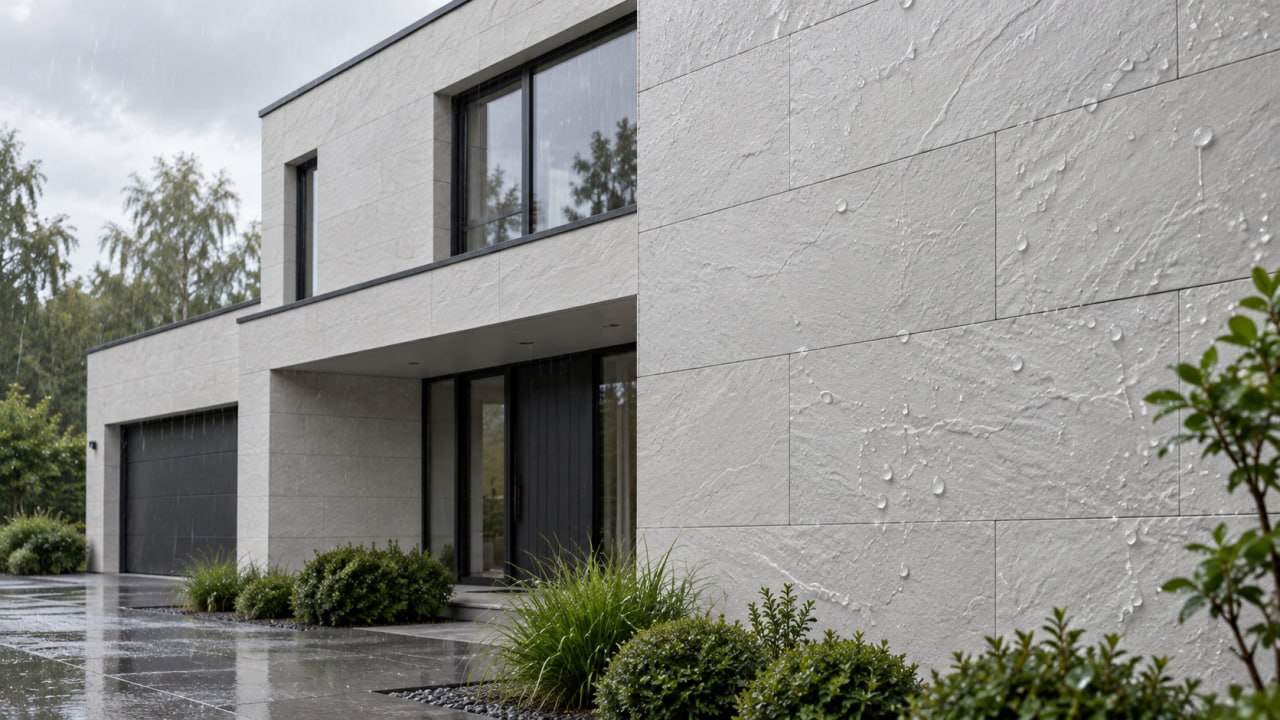
After rain, some facades dry quickly while others remain damp for a long time. On certain surfaces, water forms droplets and rolls downward without spreading much across the surface. This behavior is often referred to as the lotus effect.
However, not every moisture-resistant cladding material has this property. To understand the difference, it is important to look at how a surface interacts with water and why this matters for facade durability.
What Is the Lotus Effect and How Does It Work?
The term comes from lotus leaves, where water forms rounded droplets and easily rolls off, carrying dirt particles with it.
This behavior is caused by a combination of a specific surface microstructure and strong water-repellent properties.
A similar principle is used in some special facade coatings. Their purpose is to reduce surface wetting and make it easier for rainwater to remove dirt.
However, three different characteristics should be distinguished:
- Moisture resistance — the ability of a material to retain its properties when exposed to water.
- Water repellency — the ability of a surface to reduce water spreading and promote droplet formation.
- Lotus effect — pronounced water repellency in which droplets roll off easily and may carry away dirt.
A material can be moisture-resistant without having a pronounced lotus effect.
Why Water Can Be Dangerous for Facade Cladding
Rainwater affects more than just the decorative surface. Through cracks, damaged joints, and poorly executed junctions, it can penetrate into underlying layers.
Repeated wetting is especially problematic during cold weather. If water accumulates inside the material and freezes, its expansion can contribute to deterioration of the finish.
Persistent moisture can also create favorable conditions for biological growth and dirt accumulation.
That is why facade cladding should be evaluated not only for water repellency, but also for resistance to moisture, frost, and temperature fluctuations.
How KORDEKO Flexible Tile Interacts with Water
KORDEKO Flexible Tile (PletaFlex) is produced on a mineral-polymer base using acrylic dispersion and a reinforcing non-woven membrane.
The acrylic binder provides moisture resistance. According to the KORDEKO technical description, the tile is designed for exterior cladding and is resistant to rain, high humidity, and freeze-thaw cycles.
These properties help preserve the integrity of the decorative surface under exposure to weather.
However, the KORDEKO technical documentation does not provide water contact angle values or test results confirming a pronounced lotus effect. Therefore, it would be incorrect to claim that the tile has a self-cleaning superhydrophobic surface.
Its documented advantage is moisture resistance and resistance to atmospheric exposure, rather than guaranteed rolling of every water droplet.
Can Moisture-Resistant Cladding Help Keep a Facade Cleaner?
Moisture resistance is useful for exterior cladding, but it does not by itself prevent dirty streaks.
The appearance of the facade is also influenced by the texture of the material, the amount of dust, the direction of rainwater flow, and the condition of the drainage system.
To help keep walls cleaner, it is important to:
- Install window sills, flashings, and drip edges correctly.
- Keep gutters and downpipes in good working condition.
- Protect junctions from water penetration.
- Periodically remove dirt from the surface.
According to the manufacturer’s recommendations, KORDEKO Flexible Tile can be cleaned with water using a soft sponge or brush. The material does not require regular repainting or the repeated application of special protective treatments.
When carrying out Facade Insulation, the entire thermal insulation system must also be protected from moisture penetration. Even moisture-resistant cladding cannot replace properly sealed joints and correctly designed drainage.
The general requirements for external thermal insulation composite systems (ETICS) are set out in the European assessment documents published by EOTA.
See also: rain streaks on facades; protecting a facade from moisture and efflorescence; mold and fungi on facades: causes and protection.
Conclusion
The lotus effect is created by specific surface properties that cause water to form droplets and roll away easily, sometimes carrying dirt with it. However, moisture resistance and the lotus effect are not the same thing.
KORDEKO Flexible Tile has stated resistance to moisture, rain, and frost, making it suitable for exterior cladding. However, a pronounced lotus effect would require separate confirmation through testing.
To keep a facade dry and clean for longer, moisture-resistant cladding should be combined with proper rainwater drainage and regular maintenance.
Frequently asked questions
What is the lotus effect on a facade?
Does KORDEKO flexible tile have a lotus effect?
How do you keep a facade clean for longer?
Need advice on your facade?
- Get a free consultation for your project
- Find out which material suits your facade
- We'll answer all your questions and help you choose