


Can Flexible Tile Be Installed on OSB and Sandwich Panels Without Cracking?
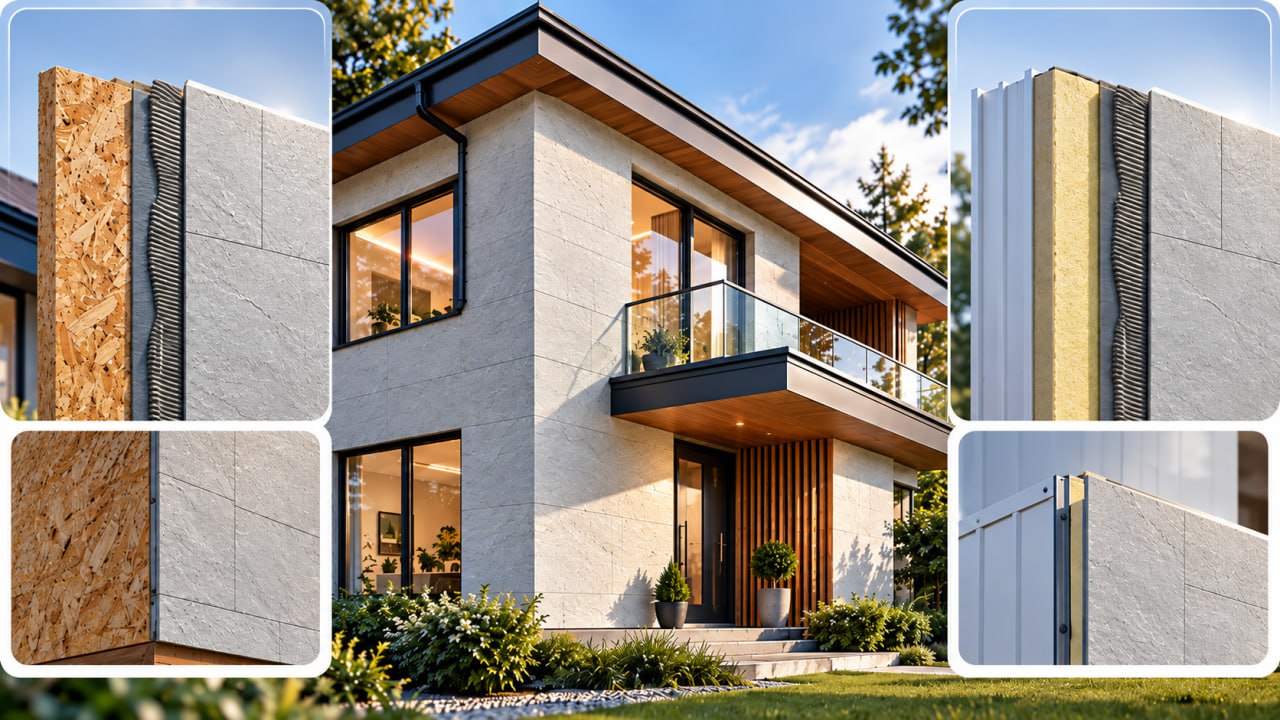
OSB and sandwich panels move with humidity and temperature, so cladding cannot be glued straight onto the board. We go through the preparation in KORDEKO’s documentation: bonding primer, levelling, fiberglass mesh, final primer, the common mistakes and what to consider when insulating a timber-frame house.
OSB boards and sandwich panels are widely used in timber-frame houses, commercial buildings, and prefabricated structures. However, when choosing facade cladding, an important question arises: will the decorative finish adhere reliably to these substrates, and will cracks appear after the first winter?
Cladding these surfaces is possible, but special preparation is required. OSB and sandwich panels behave differently from concrete and traditional plaster: they can react to changes in temperature, humidity, and mechanical loads. That is why simply applying adhesive directly to the surface is not sufficient.
Why OSB and Sandwich Panels Require a Special Approach
OSB (oriented strand board) consists of wood strands bonded together with binding agents. Its dimensions can change under the influence of moisture and temperature fluctuations.
Sandwich panels have a different structure: exterior facing layers are bonded to an internal insulation core. Their behavior depends on the type of panel, fixing method, and operating conditions.
Several characteristics must be taken into account when installing cladding:
- Substrate movement. Small deformations can transfer stress to the exterior finish.
- Surface characteristics. Some substrates have low absorbency, which can make adhesion with adhesive compounds more difficult.
- Panel joints. Local movement can occur at connections, increasing the risk of cracking.
- Moisture exposure. For OSB in particular, it is important to prevent conditions in which the board is repeatedly exposed to moisture.
If these factors are ignored, even high-quality decorative cladding may crack or begin to detach over time.
Can Flexible Tile Be Bonded Directly to OSB?
Installing flexible tile directly onto an unprepared OSB surface is not recommended.
The main issue is not only adhesion between the adhesive and the board. OSB can change in size as humidity fluctuates, meaning that a rigidly bonded decorative layer may be exposed to additional stress.
According to KORDEKO installation recommendations, an OSB substrate should first be treated, leveled if necessary, and reinforced with fiberglass mesh.
This approach creates a more suitable surface for subsequent installation of the cladding material.
At the same time, the OSB must be securely fixed and suitable for exterior operating conditions. A reinforcement layer cannot compensate for major deformation of poorly secured boards or continuous moisture exposure.
How to Prepare OSB and Sandwich Panels for Cladding
For these types of substrates, KORDEKO documentation specifies a step-by-step preparation process.
1. Prime the Surface
The first step is to apply a quartz-filled bonding primer, often referred to as concrete-contact primer.
This type of primer creates a rough surface and improves adhesion between the substrate and the following layers.
Particular attention should be paid to surface cleanliness. Dust, grease, and other contaminants can reduce adhesion.
2. Level the Substrate
If the surface has irregularities or level differences, it should be leveled using a cement-based adhesive compound.
The substrate should be sufficiently flat so that the cladding can sit evenly without voids or areas with excessive adhesive thickness.
3. Reinforce with Fiberglass Mesh
This is one of the most important preparation stages.
Fiberglass mesh is embedded into a reinforcement compound, creating a strengthened intermediate layer between the substrate and the decorative finish.
Reinforcement helps distribute stresses and reduce the risk of cracking in the exterior finish.
However, it does not replace structural movement joints and cannot eliminate movement of the panels themselves. If the construction includes movement joints, they must be taken into account when designing the facade system.
4. Apply the Final Primer
After the reinforced layer has fully dried, a deep-penetrating primer is applied.
This prepares the surface for the next stage — bonding the flexible tile.
Before continuing, it is important to make sure that the substrate is sufficiently strong and has dried in accordance with the requirements of the materials being used.
Why Flexible Tile Is Suitable for These Surfaces
KORDEKO Flexible Tile (PletaFlex) is produced on a mineral-polymer base with a reinforcing non-woven membrane.
Thanks to the acrylic binder, the material can bend without breaking, and its structure allows it to adapt to curved surfaces and minor movement of the substrate.
These characteristics are particularly useful for OSB and sandwich-panel applications.
Compared with rigid ceramic tile or natural stone, flexible cladding is better able to accommodate small deformations of a properly prepared surface.
Another advantage is its low weight. According to the KORDEKO technical description, flexible tile weighs approximately 4 kg/m². This helps limit the additional load on lightweight building structures.
However, the flexibility of the cladding does not make the entire facade system completely resistant to all movement. If the substrate deforms excessively, damage may still occur even when flexible materials are used.
Which Mistakes Most Often Lead to Cracking?
When cladding OSB and sandwich panels, problems often result not from the final material itself, but from mistakes in the installation sequence.
The most common errors include:
- No reinforcement. The cladding is bonded directly to the substrate without creating a strengthened intermediate layer.
- Incorrect primer. A product is used that does not provide the required adhesion to the specific surface.
- Insufficient leveling. Surface irregularities lead to uneven adhesive distribution.
- Ignoring panel joints. Movement between adjacent panels is not taken into account.
- Installation in unsuitable weather. Frost, high temperatures, and excessively rapid adhesive drying can negatively affect installation quality.
For exterior KORDEKO cladding, a frost-resistant adhesive is recommended, and installation should be carried out within the temperature range specified by the adhesive manufacturer.
What to Consider When Insulating an OSB Facade
If a building is constructed using timber-frame technology, facade cladding is often combined with additional thermal insulation.
Facade Insulation on such structures requires coordination between the substrate, insulation, reinforcement materials, and exterior finish.
The general requirements for external thermal insulation composite systems (ETICS) are set out in the European assessment documents published by EOTA.
The moisture behavior of the wall is especially important. Incorrectly selected layers can restrict moisture movement and create conditions for moisture accumulation within the structure.
KORDEKO Flexible Tile can be used as the final cladding of a properly prepared thermal insulation system, but the specific wall build-up should take into account the properties of the OSB, the type of insulation, and the building’s operating conditions.
When sandwich panels are used, the requirements of the panel manufacturer must also be considered, particularly regarding permitted loads, fixing of additional finishes, and thermal movement.
See also: why facades crack and how flexible tile helps avoid it; a 4 mm or 6 mm adhesive layer under flexible tile; fast facade installation without complex equipment.
Conclusion
Flexible cladding can be installed on OSB and sandwich panels, but it would be incorrect to promise that cracking can be completely eliminated. The reliability of the finish depends primarily on substrate stability, correct reinforcement, and material compatibility.
Thanks to its low weight and ability to accommodate small deformations, KORDEKO Flexible Tile is suitable for these applications when the correct surface-preparation technology is followed.
The main rule is not to bond the cladding directly to unprepared panels. Priming, leveling, reinforcement, and correct adhesive selection help reduce the risk of damage and create a more durable finish.
Frequently asked questions
Can flexible tile be glued directly onto OSB?
Does reinforcement rule out cracks on sandwich panels?
Which mistakes most often lead to cracks?
Need advice on your facade?
- Get a free consultation for your project
- Find out which material suits your facade
- We'll answer all your questions and help you choose