


Local Facade Repair: When Can a Damaged Area Be Replaced Without Redoing the Entire Facade?
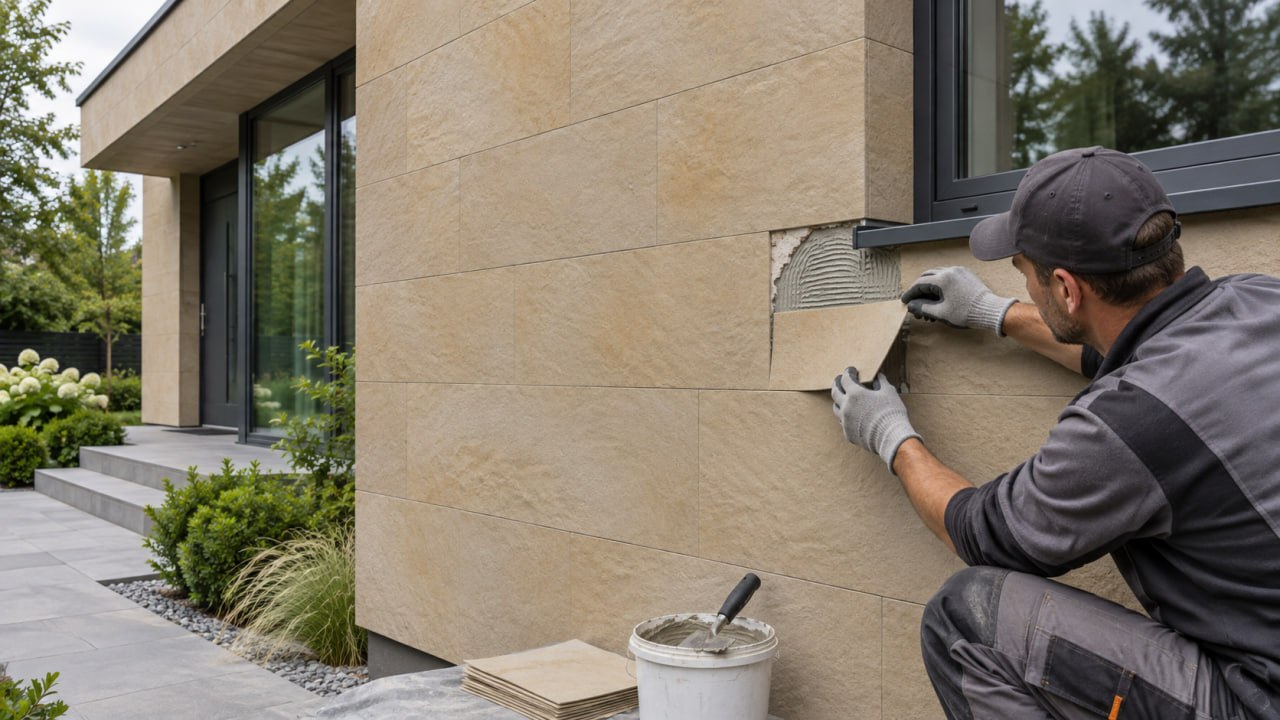
A crack, a chip or one detached tile does not mean the whole facade has to be redone. We explain when local repair is enough, why simply gluing a new tile over the problem is a mistake, how to replace a damaged KORDEKO flexible tile in four steps, and when a more serious repair is unavoidable.
A crack has appeared on the facade, a small section of cladding has chipped, or one tile has been damaged. The first question is how serious the problem is and whether the entire wall will need to be redone. Replacing the whole facade finish because of a few damaged elements is often unnecessarily expensive.
In many cases, local repair is enough. However, before restoring the finish, it is important to determine the cause of the damage and make sure the surrounding areas of the facade remain in good condition.
When Is Local Facade Repair Enough?
Minor damage does not always mean that the entire cladding system has lost its performance.
If the defect affects only one element and the surrounding surface remains strong, the repair can often be limited to the damaged area.
Local repair is usually considered in situations such as:
- Mechanical damage. A chip or impact mark has appeared on the surface.
- Damage to an individual tile. One cladding element needs replacement while the neighboring tiles remain securely bonded.
- Minor delamination. The problem is limited to a small area and the surrounding substrate remains stable.
- Local decorative defect. The appearance of a small section has been damaged, while the rest of the cladding remains in satisfactory condition.
The main requirement is that the damage must truly be local.
If the tile has detached together with the plaster, voids are found beneath the cladding, or cracks continue to spread, the condition of the substrate must be checked.
Simply replacing the damaged element without correcting the cause may lead to the same problem appearing again.
Why Shouldn’t You Simply Cover the Damage with a New Tile?
Sometimes a damaged area is repaired as quickly as possible: the loose material is removed, adhesive is applied, and a new tile is installed.
This may not be enough if the problem did not originate in the cladding itself.
For example, the tile may have detached because of a weak substrate, incorrect priming, or moisture penetration behind the finish.
In that case, the replacement element would be bonded to the same problematic surface.
Before repair, it is important to determine which layer has been damaged:
- Only the decorative cladding.
- The adhesive layer between the tile and the substrate.
- The plaster or reinforcement layer.
- The wall substrate or components of the thermal insulation system.
The required scope of repair depends on this assessment.
If the damage affects the load-bearing structure or is related to continuing movement, cosmetic repair alone will not be sufficient.
How to Replace an Individual Damaged Tile
KORDEKO technical documentation provides for the local replacement of damaged elements without removing the entire cladding system.
KORDEKO Flexible Tile (PletaFlex) is a thin mineral-polymer material reinforced with a non-woven membrane. It can be cut with a utility knife or scissors, which makes fitting individual elements easier during both installation and repair.
Local restoration generally includes several main stages.
1. Inspect the Damaged Area
First, check the condition of the neighboring tiles and the surface beneath the damaged area.
Make sure that the defect is limited to a small section and that there are no signs of further delamination around it.
2. Remove the Damaged Element
The damaged tile should be removed carefully without compromising the surrounding cladding.
If weak areas of old adhesive or plaster are found underneath, they should also be removed.
Care should be taken not to damage the reinforcement layer, especially if the facade is installed over insulation.
3. Prepare the Substrate
The surface should be cleaned of dust, dirt, and loose material.
Where necessary, the substrate should be repaired, leveled, and primed according to its type.
For absorbent mineral substrates, KORDEKO installation instructions specify the use of a deep-penetrating primer.
The replacement element should only be bonded once the substrate has been properly prepared.
4. Install the New Tile
A suitable frost-resistant adhesive should be used for exterior work.
The adhesive is distributed evenly, after which the tile is placed onto the prepared area and pressed firmly with a float to remove trapped air.
Excess adhesive should be removed promptly with a sponge.
The exact method for restoring joints depends on the existing layout and the original installation method.
The replacement tile should be securely bonded and should not protrude beyond the surrounding elements.
How Can the Repaired Area Be Made Less Noticeable?
With local repair, appearance is almost as important as bonding strength.
Even when the replacement tile is from the same model, its shade may differ slightly from the existing cladding.
The KORDEKO technical description allows for small natural shade variations typical of stone textures.
In addition, the existing facade has already been exposed to sunlight, rain, and dirt for some time, so its current appearance should be considered when selecting a replacement.
To make the repaired area less noticeable, it is recommended to:
- choose a tile from the same model, texture, and color;
- compare the replacement element with the existing cladding in natural daylight;
- take into account the direction of the texture and the pattern of neighboring tiles;
- use leftover material from the original installation whenever possible.
Preliminary comparison is especially useful on large, relatively uniform surfaces where even small shade differences may be noticeable.
When Is Local Repair No Longer Enough?
Not every defect can be corrected by replacing a few tiles.
If numerous cracks appear, the cladding is detaching over a large area, or the reinforcement layer underneath is damaged, a more thorough assessment of the facade system is required.
Particular attention should be paid to defects that reappear after previous repairs.
Possible causes include poor substrate preparation, insufficient reinforcement, structural movement, or moisture penetration.
If Facade Insulation has been installed, the insulation, fasteners, and reinforcement layer should also be checked.
The general requirements for external thermal insulation composite systems (ETICS) are set out in the European assessment documents published by EOTA.
Damage to the exterior finish is not always limited to the decorative layer. For example, water may penetrate toward the insulation through improperly executed junctions.
In such a case, replacing a single tile will not solve the underlying problem. The damaged layers must first be repaired and the system protected from further moisture exposure.
How Can the Need for Repeated Repairs Be Reduced?
The durability of facade cladding depends largely on proper substrate preparation and correct installation.
Before installation, the surface should be checked for strength, cracks and loose areas should be repaired, primer should be applied, and a suitable adhesive should be selected.
Temperature conditions during facade work also matter. KORDEKO installation instructions do not recommend installation in freezing conditions and require compliance with the adhesive manufacturer’s temperature requirements.
After completion, it is useful to inspect the most vulnerable areas periodically: the plinth, window reveals, roof junctions, and areas near gutters and downpipes.
Dirt on KORDEKO Flexible Tile can be removed with water. According to the manufacturer’s documentation, the material does not require regular repainting or the application of additional protective coatings.
Identifying small defects early makes it easier to determine their cause before the damage spreads to neighboring areas.
See also: facade maintenance: how often to clean and when to repair; why facades crack and how to avoid it; a 4 mm or 6 mm adhesive layer under flexible tile.
Conclusion
Minor facade damage does not necessarily mean that the entire cladding must be replaced. If the defect is limited to individual elements and the substrate remains strong, local repair is often the more practical solution.
KORDEKO Flexible Tile allows individual damaged elements to be replaced without dismantling the entire facade finish.
However, the main rule remains the same: first identify the cause of the damage, then carry out the repair.
If the problem affects only one tile, the repair may be relatively simple. But if the substrate, reinforcement layer, or insulation system is damaged, those defects must be corrected first; otherwise, the replacement cladding may detach again.
Frequently asked questions
Can one damaged tile be replaced without touching the rest of the facade?
Why does the new tile detach again after the repair?
How can the repaired area be made invisible?
Need advice on your facade?
- Get a free consultation for your project
- Find out which material suits your facade
- We'll answer all your questions and help you choose