


Seamless Facade or Visible Tile Layout: Which Is More Practical and Attractive?
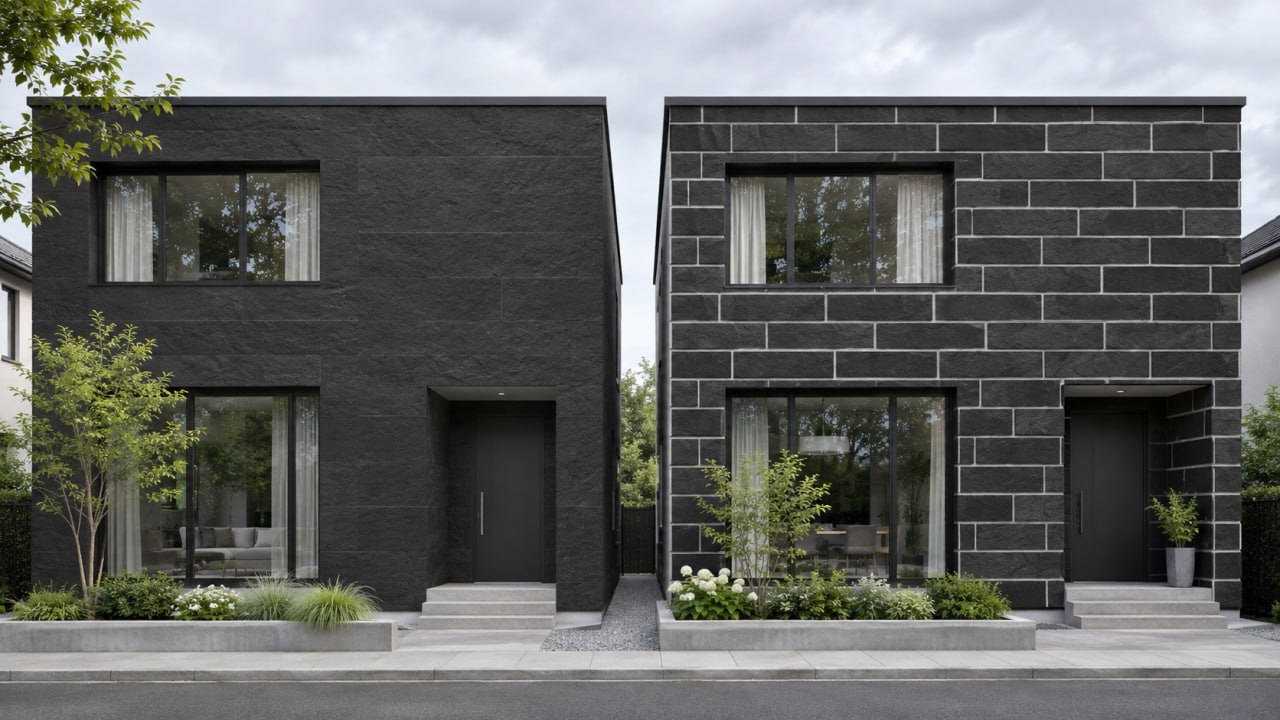
A smooth wall without joints or masonry with pronounced joints? We compare how joints change the proportions of a house, what is easier to repair — render or a single tile, how format and joint width affect the workload, and how to choose a KORDEKO flexible tile layout to suit the architecture, colour and an insulated facade.
A smooth facade without noticeable joints looks clean and unified. Cladding with visible joints creates a completely different effect: it emphasizes stone texture, resembles brickwork, or forms a geometric pattern.
But the choice between these options is not only about design. Joints influence how the size of the building is perceived, the complexity of installation, and future maintenance. At the same time, the absence of visible joints does not always mean that the facade will be more practical.
What Is the Difference Between a Seamless Facade and Cladding with a Visible Layout?
A seamless facade usually refers to a surface where the boundaries between individual finishing elements are not visible. This effect is typical of decorative render and other continuous coatings.
The surface is perceived as one uninterrupted plane without clear separation into individual tiles or blocks.
Cladding with a visible layout works differently. Here, the joints are part of the architectural design. They can emphasize horizontal lines, imitate brickwork, or create the appearance of a wall made from large stone slabs.
However, decorative joints between cladding elements should not be confused with structural movement joints. Movement joints are designed to accommodate movement within building structures and facade systems. They should not be eliminated simply to achieve a visually seamless surface.
When Does a Facade Without Visible Joints Look Better?
Continuous surfaces are often chosen for homes with modern minimalist architecture.
The absence of a pronounced layout allows attention to remain focused on the shape of the building, window proportions, projections, and the combination of main colors.
This approach is particularly suitable when:
- The house has simple geometry and large flat wall areas.
- The architecture is dominated by straight lines and large surfaces.
- The facade uses one or several calm, neutral shades.
- Different parts of the building need to appear visually unified.
However, smooth surfaces place high demands on substrate preparation.
On a large uniform wall, irregularities, cracks, signs of local repairs, and inconsistencies in the finish can be very noticeable.
For a clean result, the substrate must therefore be carefully prepared and the installation technology of the selected finish must be followed.
Why Does a Visible Layout Make a Facade More Expressive?
Joints can emphasize texture and change the visual proportions of a building.
For example, a horizontal layout using elongated elements can make a wall appear wider. Vertical tile placement, on the other hand, can emphasize the height of the building.
Brick-style layouts create a more traditional architectural character, while large rectangular elements work well on clean contemporary facades.
Tile size also plays an important role.
Smaller elements create a more detailed pattern with a greater number of lines. Large formats preserve the stone texture while making the overall surface appear calmer.
Surface relief should also be considered. A pronounced natural-stone texture may already provide enough visual interest even with a minimal number of visible joints.
That is why it is not always a good idea to combine a highly contrasting texture, complex layout, and strongly emphasized joints at the same time. In some cases, this can make the facade look too busy.
Which Is More Practical: a Smooth Facade or Tile with Joints?
There is no universal winner. Practicality depends primarily on the material, installation quality, and operating conditions.
A continuous finish has one advantage: there are fewer decorative joints where dirt can accumulate. However, local damage may be more difficult to repair without leaving a visible difference.
For example, after repairing a small area of decorative render, the new texture or shade may differ from the surrounding surface.
Tile cladding has a different advantage. If one element is damaged, it may sometimes be replaced without affecting the entire wall.
KORDEKO technical documentation provides for the local replacement of damaged tiles.
However, joints require careful installation. If they are executed incorrectly, the layout is inconsistent, or areas of insufficient adhesion remain, both the appearance and reliability of the cladding can be affected.
Therefore, the number of visible joints alone does not determine the service life of a facade.
How to Choose a Layout for KORDEKO Flexible Tile
KORDEKO Flexible Tile (PletaFlex) is available in different formats and textures that reproduce the appearance of natural stone, slate, brick, travertine, and other materials.
This makes it possible to choose between a pronounced masonry-style layout with clearly visible divisions and a calmer finish using larger-format tiles.
For example, brick-look facades naturally work well with smaller elongated elements and a traditional staggered layout. This emphasizes the character of the material.
For a modern building, large-format stone- or concrete-look tiles may be more suitable. In this case, there are fewer lines between the elements and the overall appearance becomes more restrained.
However, flexible tile still consists of individual cladding elements. A larger format can reduce the visual prominence of joints, but it does not turn tiled cladding into a completely monolithic surface.
Joint width and the method of finishing the connections should be selected according to the installation technology and the specific tile model.
Does the Number of Joints Affect Installation Cost?
Yes. The layout can noticeably affect labor requirements.
When smaller tiles are used, more individual elements must be installed, row alignment must be controlled, and the selected pattern must be maintained.
Large-format cladding reduces the number of elements on the same surface area, but requires careful positioning and even pressing.
The most difficult areas are usually around windows, doors, corners, and other architectural details. Additional cutting is required here, so preliminary layout planning is particularly important.
KORDEKO Flexible Tile can be cut with a utility knife or scissors, which simplifies fitting.
However, tile format should not be selected only according to expected installation speed. Large tiles may be inconvenient on facades with many small sections, while smaller elements may take longer to install.
The best solution depends on the geometry of the specific building.
How Does the Layout Work with an Insulated Facade?
If the cladding is installed over thermal insulation, the reliability of the entire facade system must come first.
Facade Insulation requires correct installation of the insulation, proper fixing, reinforcement, priming, and final finishing.
The general requirements for external thermal insulation composite systems (ETICS) are set out in the European assessment documents published by EOTA.
The decorative layout is selected only after taking into account the prepared substrate and the characteristics of the cladding material.
Joints between tiles do not replace reinforcement, compensate for insulation fixing mistakes, or solve water penetration problems caused by poorly executed junctions.
Regardless of how visible the layout is, facade durability depends on all layers working together correctly.
How to Match the Layout to the Architecture of the House
Before choosing a layout, it is useful to consider three main factors: the size of the facade, its geometry, and the desired visual effect.
On a small house with many windows, a very dense layout can create too many visual lines. In such cases, larger elements or less contrasting joints may work better.
On a large flat wall, a pronounced stone or brick pattern can add texture and make the surface more interesting.
If the architecture already includes many decorative details, a calmer cladding pattern is usually more appropriate so that the finish does not compete with the building itself.
Color combinations should also be considered. Light-colored joints on dark tiles emphasize geometry more strongly, while joints in a similar shade create a more uniform appearance.
The final decision is best made after reviewing samples and testing a preliminary layout over a sufficiently large area.
See also: large or small tile format: how size changes perception; how to combine stone, brick, slate and wood on a facade; local facade repair without redoing the whole facade.
Conclusion
A facade without visible joints works well with minimalist architecture and creates the impression of a continuous surface. A pronounced layout can emphasize stone or brick texture, change the perceived proportions of the building, and make the finish more expressive.
From a practical point of view, neither option is universally better. Continuous coatings can be more difficult to repair invisibly, while tiled cladding requires accurate joint execution and correct installation.
KORDEKO Flexible Tile offers different formats and layout possibilities while combining decorative stone textures with the option of replacing individual damaged elements.
The decision should therefore be based not on the number of joints alone, but on the architecture of the building, operating conditions, and quality of installation. A well-chosen layout should complement the facade rather than make it unnecessarily complicated.
Frequently asked questions
Which is more practical: a smooth facade or tile with joints?
How does the layout change how a house is perceived?
Can KORDEKO flexible tile be made completely seamless?
Need advice on your facade?
- Get a free consultation for your project
- Find out which material suits your facade
- We'll answer all your questions and help you choose