


Deep-Penetrating Primer or Concrete Contact Primer: Which Should You Choose for Wall Preparation?
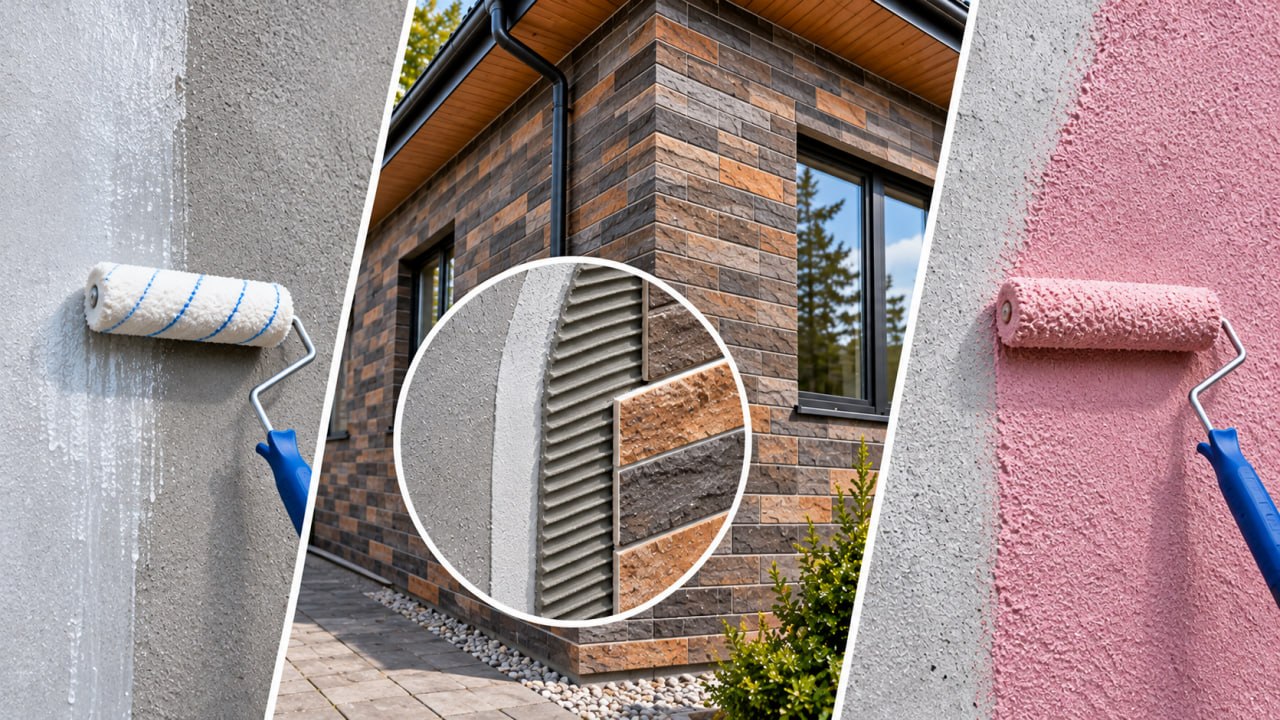
Both products improve adhesion, but they work differently: a deep-penetrating primer is for absorbent substrates, a quartz-filled concrete contact primer for dense, smooth ones. We compare them in a table, show which primer the KORDEKO instructions call for on different walls, explain why OSB and sandwich panels need both, and list five priming mistakes.
Before installing facade tile, the wall must be primed. But which primer should you use: a deep-penetrating primer or a concrete contact primer? At first glance, both products perform a similar task — improving adhesion between the finish and the substrate. However, they work differently and are intended for different types of surfaces.
Choosing the wrong primer can lead to insufficient adhesive bonding, cladding detachment, and additional repair costs. That is why there is no single universal solution for every wall.
Why Is Primer So Important for Facade Cladding?
The strength of tile adhesion depends not only on the quality of the adhesive. The condition of the surface to which the adhesive is applied is equally important.
Even a wall that looks flat can have characteristics that affect bonding, such as high absorbency, a very smooth surface, dust, or weak areas of an old coating.
Priming helps prepare the substrate for subsequent layers. However, the result depends on choosing the correct product.
For example, porous plaster and dense concrete interact with adhesive differently. A product that works well on one substrate may not provide the required result on another.
Primer also does not replace wall cleaning or repair. If the surface is crumbling, contains voids, or has areas of delamination, these defects must be corrected first.
Deep-Penetrating Primer: Which Walls Is It Suitable For?
Deep-penetrating primer is primarily used on absorbent substrates.
According to KORDEKO installation instructions, such surfaces include:
- putty;
- sandstone;
- limestone.
These materials are able to absorb liquid. When adhesive is applied, the substrate may draw water from the mixture and affect the curing conditions.
A deep-penetrating primer helps prepare a porous surface for further finishing and improves bonding conditions.
However, there is an important limitation: this type of primer is not intended to correct serious substrate defects.
If plaster is peeling or crumbling, applying primer does not guarantee that the surface will become strong enough for cladding.
Weak areas should therefore be removed, the wall cleaned, and all necessary repairs completed before priming.
Concrete Contact Primer: Why Is a Rough Surface Needed?
Concrete contact primer is mainly used on dense, low-absorbency substrates.
Unlike deep-penetrating primer, its primary purpose is to create a rough surface that allows the following adhesive layer to bond more effectively.
Quartz sand is used in the composition to create this texture.
According to KORDEKO installation instructions, concrete contact primer may be used on surfaces such as concrete, metal, plastic, and glass.
However, the suitability of a specific product for a particular substrate must always be checked in the primer manufacturer’s instructions. Not every concrete contact primer is suitable for all of these materials or for exterior facade applications.
Special care is required with smooth and non-absorbent surfaces. If the adhesive does not bond properly to the substrate, problems may appear after installation is complete.
A rough intermediate layer can improve bonding conditions, but it does not replace the need to verify compatibility between all materials in the system.
What Is the Difference Between the Two Primers?
The main difference lies in the type of substrate and the way the surface is prepared.
| Criterion | Deep-Penetrating Primer | Concrete Contact Primer |
|---|---|---|
| Main purpose | Preparation of absorbent substrates | Preparation of dense, low-absorbency surfaces |
| Typical substrates | Putty, sandstone, limestone | Dense concrete and other compatible non-absorbent substrates |
| How it works | Penetrates into the porous structure | Creates a rough bonding layer |
| Quartz sand | Not an essential feature | Used to create surface roughness |
| Selection before cladding | Based on substrate absorbency | Based on surface type and adhesive compatibility |
This means the choice should not be made only according to the name of the primer or based on the idea that one product can be used on every project.
The characteristics of the wall should be identified first, and the appropriate product selected accordingly.
Which Primer Should Be Used Under KORDEKO Flexible Tile?
KORDEKO Flexible Tile (PletaFlex) is installed on properly prepared substrates using a suitable adhesive.
The manufacturer’s installation instructions include cleaning the wall, checking flatness, repairing defects, and priming.
Primer selection depends on the type of surface.
For absorbent substrates, a deep-penetrating primer is used. For low-absorbency surfaces, a quartz-filled concrete contact primer may be used if it is compatible with the specific substrate and the following materials.
After preparation, the wall must be allowed to dry according to the requirements of the products being used.
A frost-resistant adhesive is used for exterior cladding. For light-colored KORDEKO tiles, a white-cement-based adhesive is recommended; for darker shades, a gray-cement-based adhesive is recommended.
However, even the correct adhesive cannot compensate for mistakes in priming. All layers must provide reliable adhesion to one another.
Why Do OSB and Sandwich Panels Require Additional Preparation?
OSB boards and sandwich panels require special attention.
Unlike ordinary mineral walls, these surfaces have structural characteristics and may undergo small deformations.
That is why, when installing KORDEKO Flexible Tile, simply applying primer and immediately beginning cladding is not sufficient.
The installation sequence includes:
- Treat the surface with concrete contact primer to improve adhesion.
- Level the substrate where necessary using a suitable cement-based adhesive compound.
- Reinforce the surface with fiberglass mesh.
- After the reinforcement layer has dried, apply a deep-penetrating primer.
- Begin installing the flexible tile only after the prepared surface has dried.
Both primer types are used in this build-up, but at different stages.
Concrete contact primer prepares the original surface, while deep-penetrating primer is applied before the final cladding over the prepared reinforcement layer.
The specific materials must still be compatible with one another and suitable for the panel type and exterior operating conditions.
This is a good example of why priming should not be approached with the idea of using “one primer for everything.”
How Should Walls Be Primed Over Insulation?
On an insulated facade, the decorative cladding is not installed directly onto expanded polystyrene or mineral wool. It is installed over a properly prepared reinforcement layer.
Facade Insulation involves a sequence of thermal insulation, fixing, reinforcement, priming, and final finishing.
The general requirements for external thermal insulation composite systems (ETICS) are set out in the European assessment documents published by EOTA.
Once the reinforcement layer has dried, it is prepared for the selected cladding.
Compatibility between the primer, reinforcement compound, and tile adhesive is particularly important.
The preparation method used for an ordinary concrete wall should not automatically be applied to an exterior thermal insulation system. These substrates have different characteristics, and all materials must be designed to work together.
Installation conditions must also be taken into account. Priming and tile installation should not be carried out at unsuitable temperatures or on a wet or frozen surface.
Which Priming Mistakes Lead to Problems?
Most priming problems are caused not by the absence of primer, but by using it incorrectly.
The first mistake is using the same product on every wall. Absorbent and dense substrates require different preparation methods.
The second is applying primer to a dirty surface. Dust, remnants of old coatings, and oily contamination can reduce adhesion.
The third is trying to strengthen a damaged substrate only with primer. If plaster is delaminating, the damaged area must be repaired.
The fourth is ignoring drying time. Subsequent work should only begin once the primer has reached the condition specified by the manufacturer.
The fifth is failing to check compatibility. Even a high-quality primer may be unsuitable for a particular adhesive or substrate.
Correcting these mistakes after the cladding has been installed is usually much more difficult than preparing the wall correctly before installation begins.
See also: flexible tile on OSB and sandwich panels without cracks; a 4 mm or 6 mm adhesive layer under flexible tile; facade insulation step by step: from the wall to the finish.
Conclusion
Deep-penetrating primer and concrete contact primer perform different functions. The first is intended mainly for absorbent substrates, while the second helps create a rough bonding layer on dense surfaces.
When installing KORDEKO Flexible Tile, primer selection depends on the wall material and the sequence of preparation work. On some substrates, such as OSB and sandwich panels, both types may be used at different stages.
Using one primer for every wall does not simplify the installation process — it creates a risk of incorrect substrate preparation.
Before cladding begins, the surface should therefore be assessed for strength, cleanliness, and absorbency, material compatibility should be checked, and only then should installation proceed.
Frequently asked questions
What is the difference between concrete contact primer and deep-penetrating primer?
Which primer is needed under KORDEKO flexible tile?
Why do OSB and sandwich panels need both primers?
Need advice on your facade?
- Get a free consultation for your project
- Find out which material suits your facade
- We'll answer all your questions and help you choose